

Executive summary
A forex chart looks intimidating on day one and mundane by month six. The path between those two moments is a structured process: understand the chart's basic anatomy, learn what each timeframe represents, master a small set of patterns that actually matter, and build a repeatable reading routine you can apply to any pair on any day.
This guide takes you through that process step by step. By the end, you will be able to open EUR/USD on any timeframe and produce a coherent read of trend, structure and the most likely next move — without relying on twenty indicators or on someone else's signal service.
Everything below is written for a total beginner. If you already know what a candlestick is, skim ahead to the multi-timeframe section.
Key takeaways
- A candlestick shows four prices — open, high, low, close — in one visual. Master that first.
- Every timeframe tells a different story. The daily sets the bias; the 1-hour provides entries.
- Market structure (higher highs / higher lows, or lower highs / lower lows) is the single most important read on any chart.
- Support and resistance zones are drawn from swing highs, swing lows and prior day/week levels — not from arbitrary lines.
- Build a five-minute chart-reading routine and apply it to the same pairs every day for 90 days. That single habit produces most of the early improvement.
Foundations
The three main chart types — and why candlesticks won
There are three main ways to display price on a chart: line charts (connecting closing prices), bar charts (showing open, high, low and close as bars) and candlestick charts (showing the same OHLC data as filled or hollow bodies with wicks). All three convey the same information; candlesticks convey it faster to the human eye.
Candlesticks originated in 18th-century Japan and were popularised in Western markets by Steve Nison in the 1990s. Their advantage over bars is visual: the coloured body immediately signals whether the period was bullish or bearish, and the wick shows how much the market attempted to move beyond the body before pulling back.
Almost every retail forex platform defaults to candlesticks for exactly this reason. Learn to read them and every other chart type becomes trivial.
Candlesticks
Candlestick anatomy — the four prices in one shape
Each candlestick represents one time period (1 minute, 1 hour, 1 day — whatever timeframe you have selected). Inside that period, four prices are shown:
Key points
- Open — the price at the start of the period.
- Close — the price at the end of the period. If close > open, the candle is bullish (usually green or white). If close < open, it is bearish (red or black).
- High — the highest price traded during the period. Shown as the upper wick.
- Low — the lowest price traded. Shown as the lower wick.
Patterns
The five candlestick patterns worth learning first
There are dozens of catalogued candlestick patterns. Five do most of the work in beginner-level chart reading.
Key points
- Bullish engulfing: a large bullish candle whose body fully engulfs the previous bearish candle. At support after a downtrend, it signals potential reversal.
- Bearish engulfing: the mirror image. At resistance after an uptrend, it signals potential reversal.
- Pin bar / rejection candle: a candle with a small body and a long wick in one direction. The wick shows the market attempted to move that way and was rejected. At a key level, a pin bar is one of the highest-quality single-candle signals.
- Doji: open and close at nearly the same price. It signals indecision — meaningful at key levels, noise anywhere else.
- Inside bar: a candle whose entire range is contained within the previous candle. Signals consolidation and often precedes a breakout.
Tip
Location is everything. A bullish engulfing candle at daily support after a pullback in an uptrend is high quality. The same candle in the middle of a range is noise. Never read patterns without context.
Timeframes
Timeframes — reading the same market at different resolutions
The same currency pair looks completely different on different timeframes. EUR/USD may be in a clear uptrend on the daily chart and simultaneously in a downtrend on the 15-minute chart. Both are true; they describe different time horizons of the same market.
The professional convention is to work top-down. Read the higher timeframe first for bias and major levels, then move to the execution timeframe for entries. A common combination for swing traders: weekly (macro trend), daily (structure and levels), 4-hour (setup formation), 1-hour (entry timing). For day traders: daily (bias), 1-hour (structure), 15-minute (setup and entry).
| Timeframe | Best used for | Typical trader type |
|---|---|---|
| Weekly (1W) | Long-term trend and macro levels | Position trader |
| Daily (1D) | Trend bias and major structure | All timeframes |
| 4-hour (H4) | Swing structure and setup formation | Swing trader |
| 1-hour (H1) | Intraday structure, swing entries | Swing / intraday |
| 15-min (M15) | Intraday setups and entries | Day trader |
| 5-min / 1-min | Scalping and news trading | Scalper (advanced) |
Compare brokers before you deposit
Independent rankings on regulation, spreads, platforms and best-fit trader profiles at BrokerTrusted.
Structure
Market structure — the single most important read
Before drawing any indicator, look at the sequence of highs and lows. An uptrend shows higher highs and higher lows: each pullback bottoms above the previous pullback, and each rally tops above the previous rally. A downtrend shows the opposite. A range shows no clear directional structure — highs and lows oscillate around a mean.
This single read tells you which strategies have positive expectancy on this chart, at this moment. Trend-following systems (buy pullbacks in uptrend, sell rallies in downtrend) have positive expectancy in trending structure and get chopped in ranges. Mean-reversion systems (fade extremes at range boundaries) have the opposite profile.
Structure changes when the pattern breaks: an uptrend confirms it is over when price makes a lower low that breaks the last higher low. Not before.
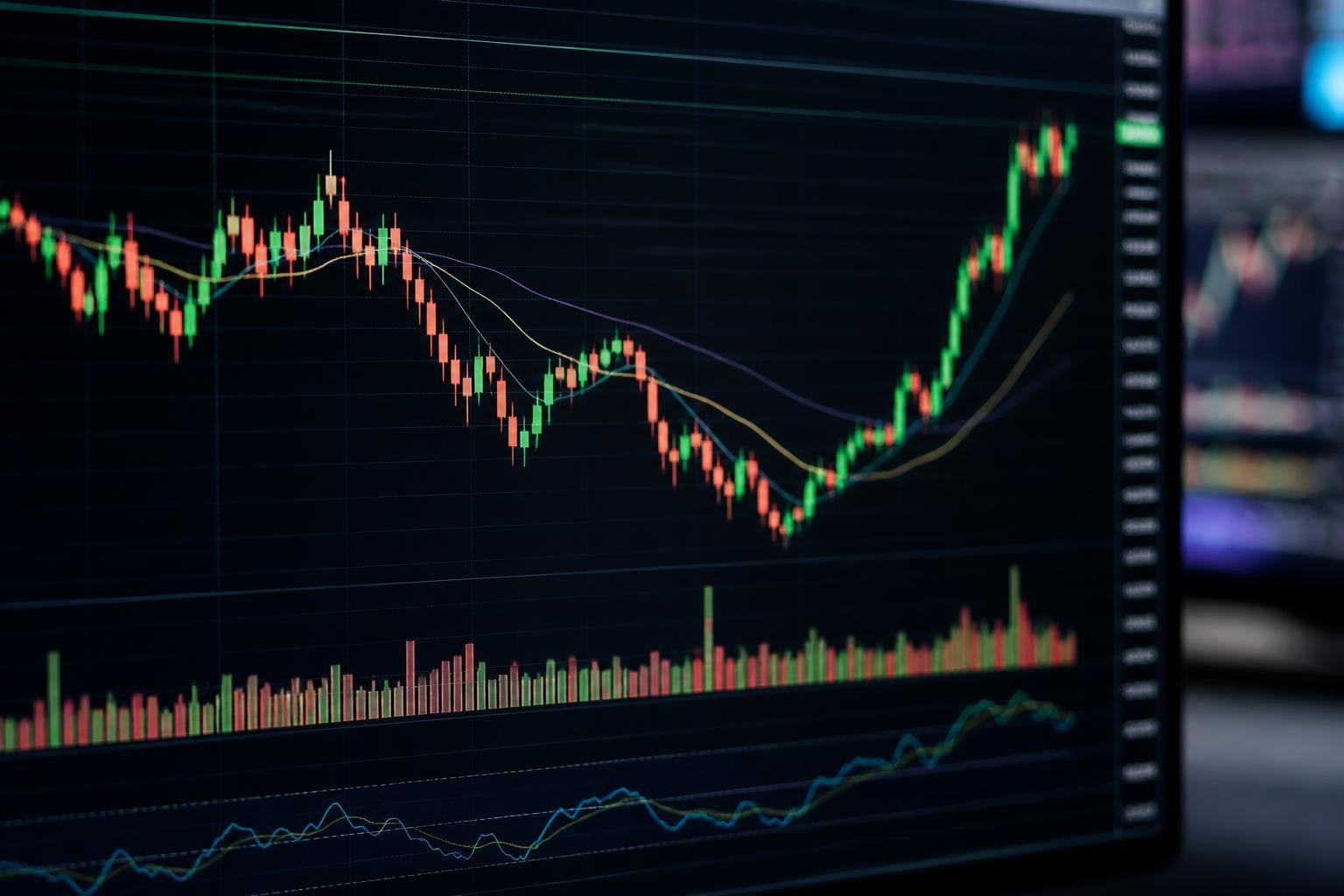
SEO description: Reference image for the sections on candlestick anatomy, market structure and multi-timeframe reading.
Levels
Support and resistance — how to draw meaningful levels
Support is a price zone where buying has historically been strong enough to halt or reverse declines. Resistance is the mirror — a zone where selling has been strong enough to halt or reverse rallies. Drawing them well is a skill; most beginners over-draw and end up with charts covered in lines.
The most robust levels come from higher-timeframe swing highs and swing lows, previous day/week high/low/close, and round numbers (1.10, 1.15, 100.00). Ignore intraday micro-levels — they add noise without adding edge. Draw levels as zones (a small horizontal band), not as single-price lines: real market reactions happen inside a range, not at a mathematically exact price.
Indicators
The two indicators worth adding at the beginner stage
Beginners should resist the temptation to load ten indicators onto every chart. Two do more work than any combination of ten: the 50-period moving average (as a dynamic trend and pullback reference) and the RSI (as a momentum and divergence gauge). Master those before adding anything else.
Use the 50 SMA on the daily and 4-hour timeframes as a trend filter: price above the 50 SMA in a clear uptrend = long bias; below in a clear downtrend = short bias. Use the RSI to spot momentum divergences: when price makes a new low but RSI does not, or vice versa, it is a warning of potential exhaustion.
Routine
A five-minute chart-reading routine you can apply every day
Consistency comes from applying the same process to every chart, every day. Here is a five-minute routine that covers the fundamentals for any pair on any day.
Step-by-step checklist
- 1Open the weekly chart. Read structure — uptrend, downtrend or range? Mark the last swing high and swing low.
- 2Open the daily chart. Confirm structure. Mark the 50 SMA and note whether price is above or below it. Draw the two nearest major support and resistance zones.
- 3Open the 4-hour chart. Identify the last swing high and swing low. Note whether momentum is confirming the daily trend or diverging.
- 4Open your execution timeframe (1H or 15M). Look for setups only in the direction of the daily bias — pullbacks in uptrend, rallies in downtrend.
- 5Write down one sentence: what does this chart tell me is the highest-probability next move, and where would I enter?
Insight
Apply this routine to the same three pairs every day for 90 days. That single habit will teach you more about chart reading than any course.
Mistakes
The five most common chart-reading mistakes beginners make
Key points
- Trading the 5-minute chart without ever checking the daily bias — the fastest way to fight the trend.
- Drawing too many support and resistance lines until every candle is 'near a level'.
- Reading candlestick patterns without location — a doji in the middle of nowhere means nothing.
- Loading ten indicators that give conflicting signals, producing analysis paralysis.
- Changing your read every hour instead of committing to a bias and revising it only on structure breaks.
Compare brokers before you deposit
Independent rankings on regulation, spreads, platforms and best-fit trader profiles at BrokerTrusted.
Next
Next steps — turning chart reading into a real skill
Chart reading is a perishable skill. It improves with repetition and decays without it. Once you can run the five-minute routine above from memory, the next step is journaling: for every real setup you take, screenshot the chart at entry, at exit, and add one sentence on what the chart told you before the trade and whether that read was correct.
Over 100 trades, patterns emerge — the setups where your chart read is consistently right, and the ones where you consistently misread. Doubling down on the first and eliminating the second is where most of the real improvement in the first two years comes from.
Recommended internal reads
Trusted external sources
Verified references from high-authority sources supporting the regulation, platform and investor-protection concepts in this guide.
See the best forex brokers ranking
Before opening an account, compare brokers by regulation, spreads, platforms, reputation, bonuses, support and trader profile. The BrokerTrusted ranking helps you filter options with clarity.
See best forex brokersFrequently asked questions
What is the best chart type for forex?
Candlestick charts are the default for retail forex trading because they show open, high, low and close in a single visual and highlight bullish vs bearish periods by colour. Bars and line charts show the same information less efficiently for the human eye.
What is the best timeframe for beginners?
The daily and 4-hour combination is ideal for beginners. It provides enough setups to learn from without the noise and stress of lower timeframes, and it fits comfortably around a full-time job. Sub-15-minute timeframes require more experience to trade profitably.
How do I know if a pair is in an uptrend?
An uptrend shows a sequence of higher highs and higher lows on the timeframe you are analysing. Each pullback should bottom above the previous pullback, and each rally should top above the previous one. When that pattern breaks (a lower low breaking the last higher low), the trend is no longer confirmed.
Which candlestick patterns should I learn first?
Five patterns cover most of what a beginner needs: bullish engulfing, bearish engulfing, pin bar (rejection candle), doji and inside bar. All five are only high-quality signals when they occur at pre-identified support or resistance levels — location is more important than the pattern itself.
Do I need indicators to read forex charts?
No. A trader can build a complete analysis process using only price action, market structure and support/resistance zones. Indicators like the 50 SMA and RSI can add confirmation but are not required. Many professional traders use very few indicators or none at all.
How long does it take to learn to read forex charts?
The mechanics can be learned in a few weeks. Reading charts well enough to make consistent trading decisions typically takes 12–24 months of daily practice, journaling and iterative refinement. It is a genuine skill, not a shortcut.
Related articles

How to Choose a Trusted Forex Broker in 2026: The Complete Due-Diligence Guide
A senior-level guide to picking a trusted forex broker in 2026 — how to verify regulation, evaluate segregation of funds, compare real costs and spot red flags before you deposit.

Forex Spreads and Real Trading Costs in 2026: How to Compare Brokers Like an Analyst
Learn how to compare forex brokers by their real trading cost — spread, commission, swap and slippage — with worked examples on major and minor pairs.
Forex Technical Analysis 2026
The next step after chart reading — indicators, patterns and price action that actually work.
Forex vs Stocks 2026
Should you be reading forex charts at all, or does your profile fit stocks better?