
Executive summary
Technical analysis in forex has a marketing problem. YouTube is full of indicators that 'never fail' and courses selling 90% win-rate systems. The reality of institutional trading is much more mundane: a small number of well-understood tools, applied consistently, in the direction of higher-timeframe structure.
This guide covers what actually works: the three or four indicators worth learning, the chart patterns supported by decades of data, the price-action concepts institutions actually watch, and the framework that turns any of them into a repeatable process.
Nothing here promises certainty. What it does promise is a rigorous starting point for building your own analytical process — one that you can back-test, journal and improve.
Key takeaways
- Master three or four tools deeply — not twenty superficially.
- Higher-timeframe structure dictates lower-timeframe bias. Always work top-down.
- Support and resistance, moving averages and momentum divergences generate more consistent edges than complex indicator stacks.
- Confluence — two or more independent signals aligning — is where higher-probability setups appear.
- Every technical setup must be defined in terms of entry, stop and target before you take it.
Foundations
Start with market structure — the foundation everything else sits on
Before any indicator, before any pattern, the first read on a chart is market structure: is price making higher highs and higher lows (uptrend), lower highs and lower lows (downtrend), or oscillating in a range? This single question decides which strategies have positive expectancy on this chart, at this time.
Trend-following strategies (MA pullbacks, momentum breakouts) have positive expectancy in trending structure and get chopped in ranges. Mean-reversion strategies (RSI extremes, range fades) have the opposite profile. Trading a trend system in a range is the single most common cause of retail losses; the analysis was not wrong, the environment was.
Read structure top-down: weekly, then daily, then 4-hour, then whatever execution timeframe you use. Higher timeframes set bias; lower timeframes provide entries.
Insight
If you can only take one habit from this guide, take this: never enter a trade on the 15-minute chart without first knowing the direction of the daily.
Levels
Support and resistance — the levels that matter
Support and resistance zones are simply price areas where enough participants have historically reacted to change the short-term direction of the market. They are self-fulfilling to a degree: because everyone watches them, everyone acts around them, which reinforces their significance.
Draw levels from higher-timeframe swing highs and swing lows first. Add round numbers (1.10, 1.15 on EUR/USD), previous session highs/lows and the prior day's high/low/close. Ignore intraday micro-levels — they add noise without adding edge.
The most tradeable interactions with a level are (1) a clean rejection at the first test, and (2) a break-and-retest where price closes through the level, pulls back, and then continues in the direction of the break.
Indicators
Moving averages: the simplest useful indicator
Moving averages smooth price to reveal trend direction and dynamic support/resistance. Two settings do 80% of the work: the 50-period simple moving average (SMA) as a medium-term trend proxy, and the 200-period SMA as a long-term trend and institutional reference level.
The most robust setup is the pullback: in an uptrend on the daily chart, buy pullbacks toward the 50 SMA that reject with confirmation on the 4-hour. Stop below the recent swing low; target a prior swing high or a 1:2 risk-reward multiple. This setup has been documented in dozens of published trend-following studies going back to the 1970s.
Indicators
RSI — how to use momentum without getting whipsawed
The Relative Strength Index measures the ratio of average up-closes to down-closes over a lookback period, scaled 0–100. Retail lore treats >70 as 'overbought' and <30 as 'oversold' — signals to fade. In practice, in strong trends, RSI can stay above 70 for weeks. Fading it costs money.
The professional use of RSI is different. In trending markets, use it for pullback timing: in an uptrend, buy when RSI dips into 40–50 on the lower timeframe and then turns back up. In ranging markets, use the classical 70/30 extremes with a reversal candle at a resistance/support level for confluence.
The highest-quality signal RSI produces is divergence: price makes a new low, RSI does not. That divergence, at a higher-timeframe level, is one of the more reliable warning signs of exhaustion.
Compare brokers before you deposit
Independent rankings on regulation, spreads, platforms and best-fit trader profiles at BrokerTrusted.
Indicators
MACD — trend and momentum in one line
The Moving Average Convergence Divergence is the difference between a 12-period and a 26-period EMA, with a 9-period signal line and a histogram. It gives three signals: the MACD-signal crossover (trend change), the zero-line cross (trend confirmation) and histogram divergence (momentum shift).
The most useful MACD read is on the higher timeframe: the daily MACD histogram tells you whether the current move is accelerating or decelerating. Combined with structure and moving averages, it filters out most low-quality entries.
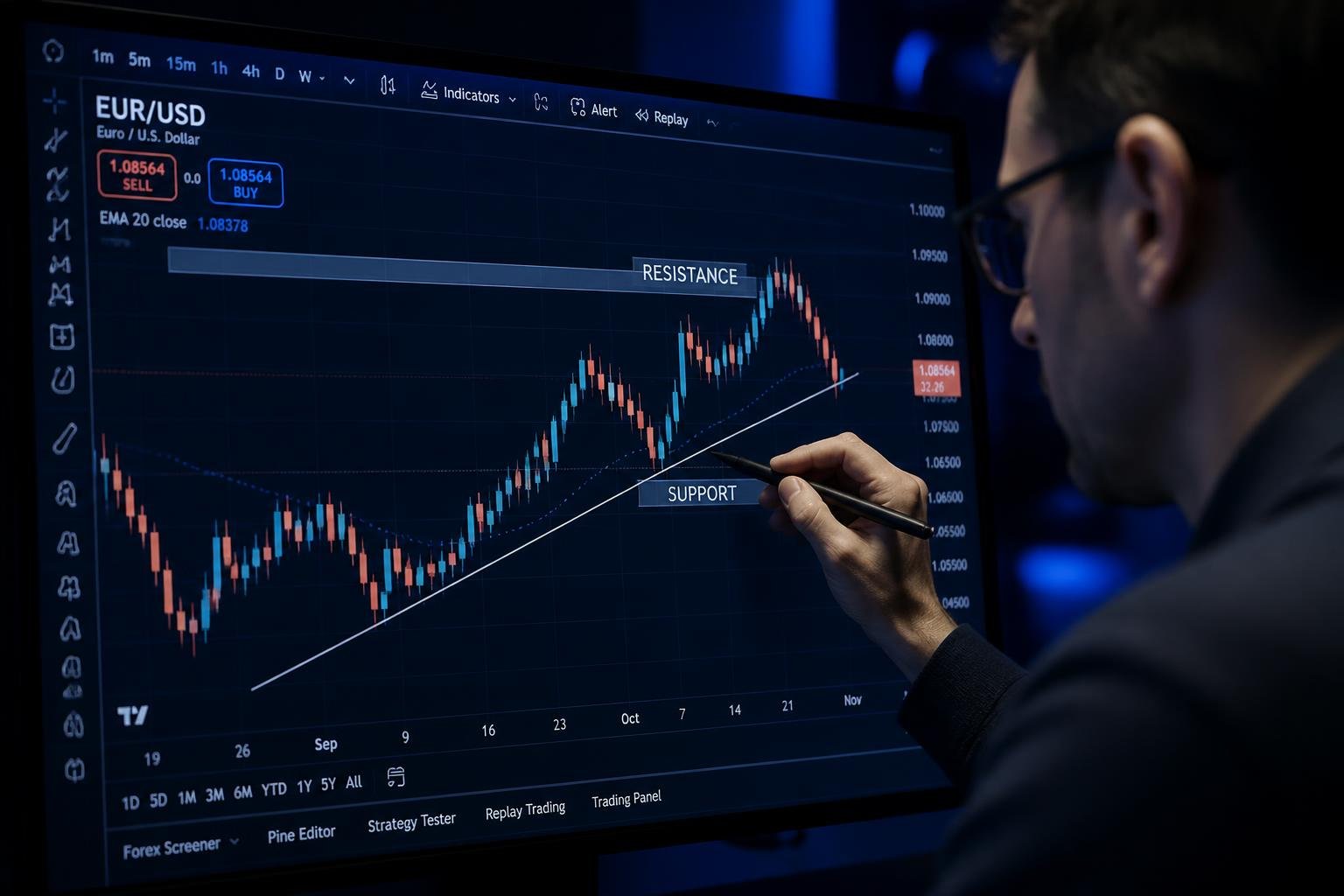
SEO description: Visual reference for the section on combining indicators, structure and price action into a repeatable process.
Price action
Candlestick patterns worth learning
There are dozens of catalogued candlestick patterns; most are not statistically meaningful on their own. Four are: the pin bar / rejection candle, the engulfing pattern, the inside bar, and the morning/evening star. All four are read the same way — as a rejection or continuation signal at a pre-identified level.
The critical qualifier is location. A bullish engulfing candle in the middle of nowhere is noise. A bullish engulfing candle at a daily support level after a pullback in an uptrend is a high-quality setup.
Patterns
Classical chart patterns: what still works
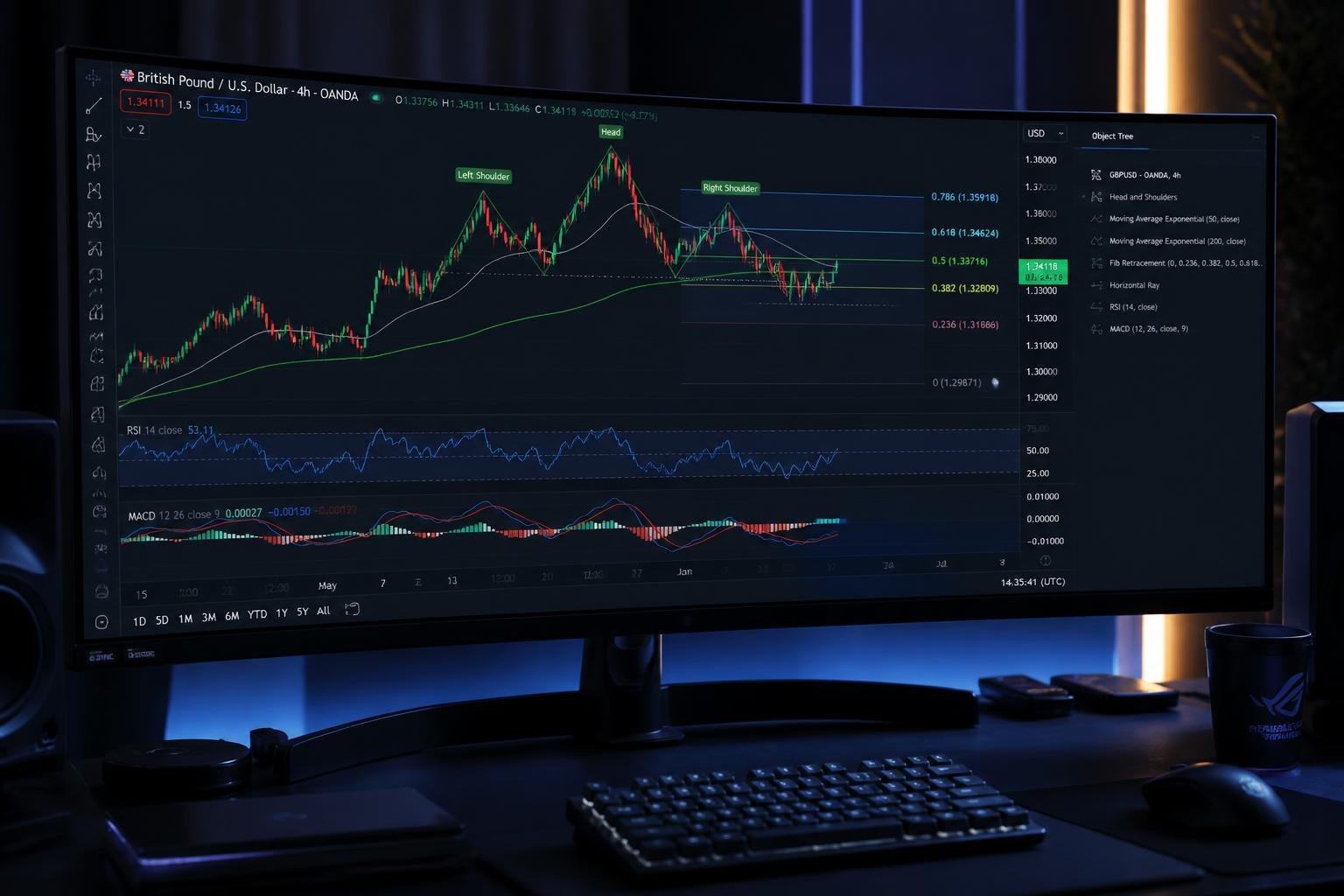
The four chart patterns supported by the best empirical evidence in forex are: the double top/bottom, the head and shoulders (and inverse), the ascending/descending triangle, and the bull/bear flag. Each has clear entry, stop and target rules.
The double top forms as two peaks at approximately the same level, with a defined neckline in between. Enter short on the break of the neckline, stop above the second peak, target a projection equal to the height of the pattern.
Bull/bear flags are continuation patterns — a sharp impulse move (the pole) followed by a small counter-trend consolidation (the flag), with breakout in the original direction. On strong trends they are among the highest-probability setups available to retail traders.
Method
Confluence: where high-probability setups actually appear
The single most important shift for most retail traders is moving from 'a signal fired, so I enter' to 'multiple independent signals align at this level, so I enter'. Confluence is the difference between guessing and analysing.
A high-quality confluence setup might look like: (1) daily uptrend intact, (2) price pulled back to a 4-hour support level that coincides with the 50 SMA, (3) 4-hour RSI turned up from the 40 zone, (4) an hourly bullish engulfing candle formed at the level. Any single one of these is noise; all four together is a plan.
Tip
Define your minimum confluence in advance. For example: 'I will only take trades with at least three of the following six factors aligned.' This alone will eliminate 60% of your low-quality trades.
Process
Turning analysis into a repeatable process
Analysis without process is entertainment. To turn technical analysis into a source of edge, every setup you take should be defined in a written plan with entry criteria, stop placement, target methodology, position size and post-trade review. Journal every trade, tag them by setup type, and after 50 trades measure win rate, average R multiple and expectancy per setup.
Over time, you will find that two or three specific setups do most of your profit, and a long tail of low-probability trades leak capital. Ruthless removal of the tail is where most retail traders make their real jump in performance.
Compare brokers before you deposit
Independent rankings on regulation, spreads, platforms and best-fit trader profiles at BrokerTrusted.
Recommended internal reads
Trusted external sources
Verified references from high-authority sources supporting the regulation, platform and investor-protection concepts in this guide.
See the best forex brokers ranking
Before opening an account, compare brokers by regulation, spreads, platforms, reputation, bonuses, support and trader profile. The BrokerTrusted ranking helps you filter options with clarity.
See best forex brokersFrequently asked questions
Which forex indicator is most accurate?
No indicator is 'most accurate' in isolation. Moving averages, RSI and MACD each have documented edges in the right market environment. Consistency comes from combining a small number of tools with disciplined higher-timeframe context, not from finding a magical indicator.
How many indicators should I use?
Three is a good ceiling for most traders: one for trend (moving averages), one for momentum (RSI or MACD), and one for volatility or volume context (ATR or volume profile). Beyond that, indicators start conflicting with each other and produce analysis paralysis.
Does technical analysis work in forex?
Technical analysis works to the extent that enough participants act on the same signals, creating self-reinforcing behaviour around key levels and patterns. In forex, where liquidity is deep and participants highly professional, the edges are smaller than marketing suggests but they exist — especially at multi-timeframe confluence.
What is the best timeframe for forex analysis?
The daily timeframe is the most robust for bias and structure. For entries, most retail traders benefit from the 4-hour and 1-hour combination. Sub-15-minute timeframes are noisier and require more experience to trade profitably.
Are chart patterns reliable?
The four patterns with the strongest empirical support in forex are the double top/bottom, head and shoulders, triangles and flags. They are reliable when combined with market structure and confluence — not when traded in isolation on lower timeframes.
How long does it take to learn technical analysis?
The concepts can be learned in weeks. Applying them profitably takes 12–24 months of live screen time, journaling and iterative refinement. Most traders underestimate the second number by an order of magnitude.
Related articles

How to Choose a Trusted Forex Broker in 2026: The Complete Due-Diligence Guide
A senior-level guide to picking a trusted forex broker in 2026 — how to verify regulation, evaluate segregation of funds, compare real costs and spot red flags before you deposit.

Forex Spreads and Real Trading Costs in 2026: How to Compare Brokers Like an Analyst
Learn how to compare forex brokers by their real trading cost — spread, commission, swap and slippage — with worked examples on major and minor pairs.
How to Read Forex Charts — Beginner's Guide
Start-here guide to reading candlestick charts, timeframes and basic patterns.
Forex Risk Management 2026
Turn technical setups into profitable trades with proper position sizing.