
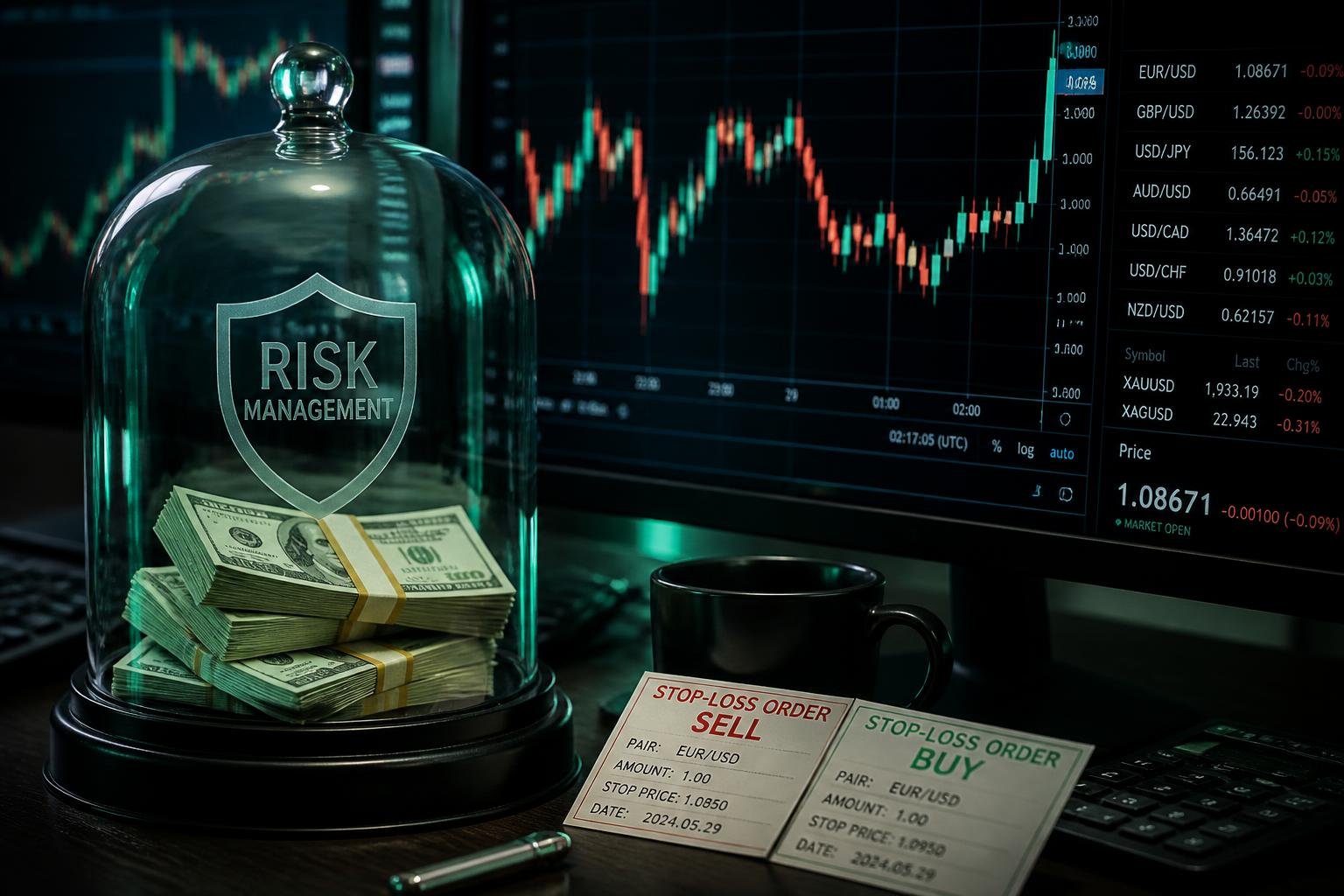
Executive summary
Every experienced trader eventually converges on the same conclusion: risk management, not entry accuracy, is the single largest driver of long-term outcomes. Two traders with identical setups but different risk rules will end up with completely different equity curves.
This guide covers the risk framework used at professional prop firms and adapted for retail forex — the arithmetic behind position sizing, why fixed-fractional risk works, how to place stops that respect market noise, and how to build portfolio-level controls that prevent one bad week from becoming one bad year.
None of this is glamorous. All of it works.
Key takeaways
- Risk per trade should be fixed as a percentage of equity — the 1% rule is the industry standard for retail.
- Stops belong at levels invalidated by market structure, not at round pip numbers.
- Risk-reward matters, but expectancy (win rate × avg win − loss rate × avg loss) is what defines profitability.
- Portfolio heat — total open risk across positions — must be managed at the account level, not per trade.
- A trading journal that tracks R multiples per setup is the fastest tool for performance improvement.
Foundations
Why risk management is the actual edge
Retail traders spend an average of 90% of learning time on entries and 10% on risk. Professional traders invert that ratio. The reason is arithmetic: a trader with a 45% win rate and a 2:1 risk-reward ratio is profitable; a trader with a 65% win rate and a 1:2 risk-reward ratio is not. Entries are worth much less than the risk rules applied to them.
A well-designed risk framework does three things: it caps the damage of any single trade, it prevents cascading losses from correlated positions, and it stabilises the equity curve enough that you can survive the inevitable stretches of variance. Without it, even a positive-expectancy strategy will fail — because the drawdowns force emotional deviations that destroy the edge.
Position sizing
Risk per trade: the 1% rule and its variants
The industry default for retail forex is 1% of equity risked per trade. On a USD 10,000 account that is USD 100. This risk is measured to your stop — meaning: if your stop is hit, you lose USD 100, no more.
Some experienced traders use 0.5% for conservative strategies or 2% for high-conviction setups. Above 2%, the arithmetic of drawdown becomes hostile: a 20-trade losing streak (which happens even to profitable systems) at 3% risk per trade produces a 46% drawdown. Recovering from that requires an 85% gain on remaining capital. Very few traders survive that mentally, whatever the entry setup was.
Position size follows automatically from risk. On a USD 10,000 account, USD 100 risk, EUR/USD trade with a 25-pip stop: pip value must be USD 4, which is 0.4 standard lots. The formula never changes — only the inputs.
Tip
Compute position size before you place the order, every time. Never adjust the stop to fit a position you already like the size of. That single discipline change eliminates the majority of retail blow-ups.
Stops
Stop placement: below the level, not at the round number
A stop-loss belongs where your trade thesis is invalidated. If you bought a pullback to daily support, your thesis is invalidated below that support — not 10 pips below it, not at a nice round number, but at the level where the market has told you 'this is not what I thought it was'.
Placing stops at obvious round numbers (1.1000, 1.2000) makes them predictable. Institutional flow routinely pushes to those levels to trigger stops and then reverse — the classic stop-hunt pattern. Better placement: below the swing low that defines the structure, with a small buffer for spread and volatility (ATR-based).
Trailing stops and break-even stops can protect winners but should not be used mechanically. Moving a stop to break-even too early converts a winning trade into a scratch trade because normal market noise triggers the stop before the target is reached.
Math
Risk-reward, win rate and expectancy
Risk-reward ratio is the ratio of your target distance to your stop distance. A 2:1 setup risks 1R (1% of equity) to make 2R. This is a useful shortcut, but the number that matters is expectancy: (win rate × average win) − (loss rate × average loss).
A system with 40% win rate and 3:1 average R produces expectancy of (0.4 × 3) − (0.6 × 1) = +0.6R per trade. A system with 60% win rate and 1:1 R produces (0.6 × 1) − (0.4 × 1) = +0.2R per trade. The first system is three times more profitable — despite the lower win rate. Never optimise for win rate alone.
Compare brokers before you deposit
Independent rankings on regulation, spreads, platforms and best-fit trader profiles at BrokerTrusted.
Portfolio
Portfolio heat: managing risk across positions
Risk per trade is only half the story. Total open risk across all positions — portfolio heat — is the number that determines your worst-case day. If you have five open positions each at 1% risk, your portfolio heat is 5% of equity. If all five happen to move against you in a single correlated event (a USD-strength day), you take a 5% drawdown.
Set a portfolio heat cap. Most professional traders operate at 3–5% total heat maximum. When the cap is reached, no new positions are opened until existing ones are closed or de-risked.
Key points
- Never hold more than 3–5% total open risk at any time.
- Treat correlated positions as effectively one position when computing heat.
- Reduce risk per trade during drawdown periods, not increase it.
- Have a hard weekly loss limit (e.g. 3% of equity) after which trading stops for the week.
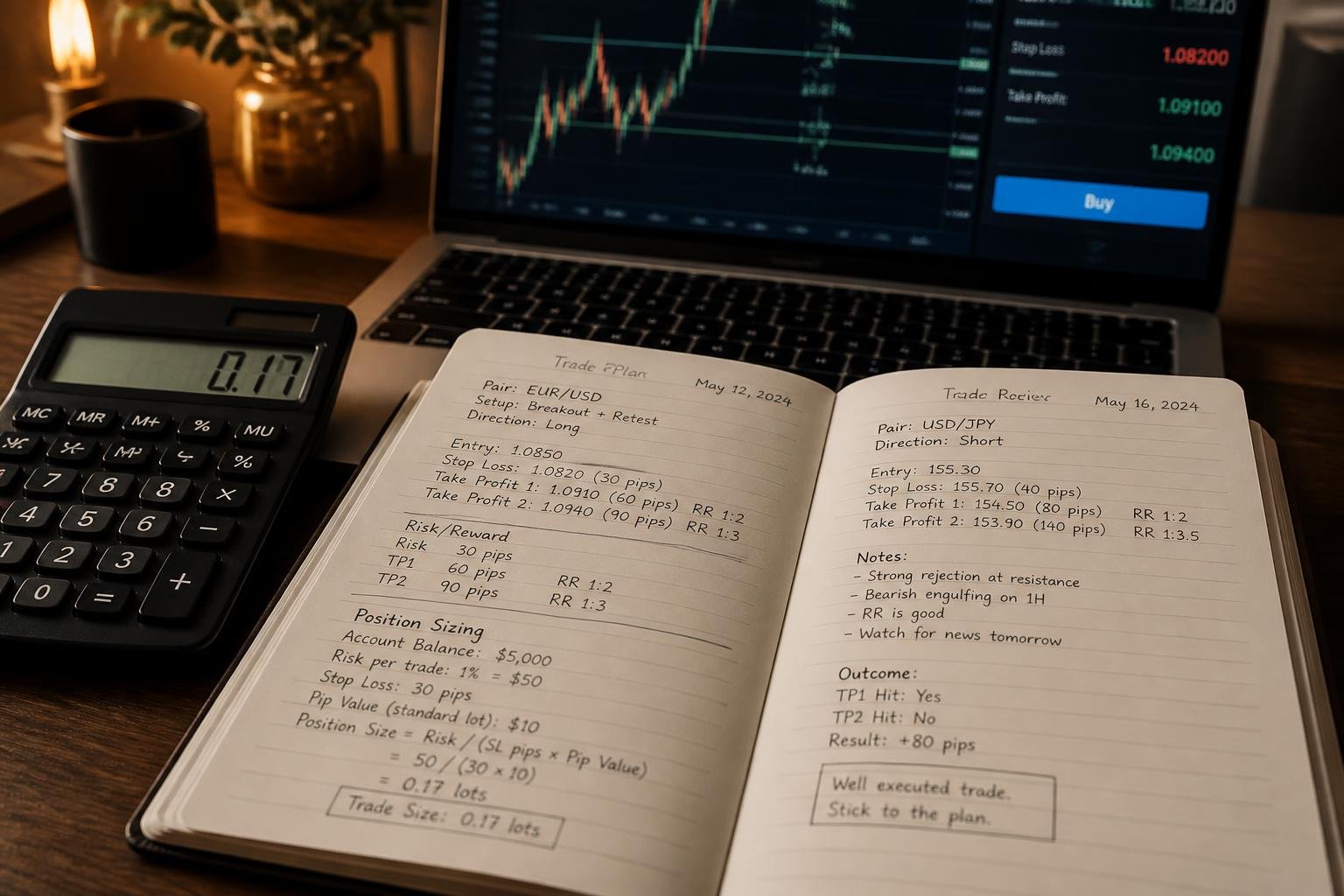
SEO description: Reference image for the section on journaling, R-multiple tracking and expectancy calculation.
Correlation
Correlation: when 'diversified' positions are one position
Long EUR/USD, short USD/CHF and long AUD/USD look like three different trades. In reality they are one bet: USD weakness. If the USD strengthens sharply, all three positions lose simultaneously. This is why professional traders classify positions by underlying exposure, not by symbol.
The practical rule: sum notional USD exposure across positions and treat that as one position for portfolio heat purposes. If you must hold multiple correlated positions, reduce risk per trade so total correlated risk stays within cap.
Drawdown
Drawdown rules: what to do when you're losing
Every profitable trader has losing streaks. What separates survivors from casualties is the response. The pro response is mechanical: at −5% drawdown, cut risk per trade in half. At −10%, stop trading and review. At −15%, take a full week off before touching the platform.
The retail response — increase size to 'make it back' — is the single most reliable path from a manageable drawdown to a blown account. Codify your drawdown rules in advance, in writing, when you are calm. Then follow them when you are not.
Warning
Revenge trading after a loss is the classic account killer. If you feel the urge to immediately re-enter after a stop-out, close the platform for the day.
Journal
The trading journal: the highest-ROI tool in the business
Every trade you take should be logged with: setup type, entry, stop, target, position size, R risked, R result, screenshot at entry, screenshot at exit, and post-trade notes on execution and psychology. After 50 trades, group by setup type and compute win rate, average R, expectancy and total R per setup.
The insight almost every trader discovers when they do this seriously: 20% of their setups produce 80% of profits, and a long tail of low-quality setups leaks capital. Eliminating that tail — with no other change — often turns a break-even trader into a profitable one.
Checklist
Risk management checklist for every trade
Step-by-step checklist
- 1Is this trade within my written strategy criteria? If not, skip.
- 2What is my dollar risk (1% of equity)?
- 3Where is my stop placed based on market structure?
- 4What position size does that stop distance imply?
- 5Is my target based on a real structural level, not a wish?
- 6Does this position push me over my 3–5% portfolio heat cap?
- 7Am I already at daily/weekly loss limit? If yes, no new trades.
- 8Have I logged the plan before entering?
Compare brokers before you deposit
Independent rankings on regulation, spreads, platforms and best-fit trader profiles at BrokerTrusted.
Recommended internal reads
Trusted external sources
Verified references from high-authority sources supporting the regulation, platform and investor-protection concepts in this guide.
See the best forex brokers ranking
Before opening an account, compare brokers by regulation, spreads, platforms, reputation, bonuses, support and trader profile. The BrokerTrusted ranking helps you filter options with clarity.
See best forex brokersFrequently asked questions
What is the best risk-reward ratio for forex?
There is no universal best ratio. What matters is expectancy: (win rate × average win) − (loss rate × average loss). A system with 40% win rate and 3:1 R is more profitable than one with 60% win rate and 1:1 R. Design the ratio to match your strategy, not the other way around.
How much should I risk per trade?
The industry standard for retail forex is 1% of account equity per trade. Conservative traders use 0.5%; high-conviction discretionary traders occasionally use 2%. Above 2%, drawdown mathematics becomes hostile and psychological pressure destroys most strategies.
Where should I place my stop loss?
Stops belong at price levels where your trade thesis is invalidated — below the swing low that defines the structure, with a small buffer for spread and volatility (typically 0.5–1× ATR of the timeframe). Never place stops at round pip numbers; they are the most predictable and most hunted.
What is portfolio heat?
Portfolio heat is the total percentage of account equity at risk across all open positions. Most professional traders cap it at 3–5%. When the cap is reached, no new positions are added until existing ones are closed or de-risked.
How do I recover from a big drawdown?
Cut risk per trade, review your last 20 trades against your written strategy, identify whether the drawdown came from strategy failure or discipline failure, and only scale risk back up after a defined recovery in equity. Do not increase size to 'catch up' — that is the classic path to a blown account.
Is 2% risk per trade too much?
Two percent is on the aggressive end of what is defensible for retail forex. Twenty consecutive losses at 2% risk produce a 33% drawdown; recovering requires a 50% gain on remaining capital. If your strategy has been forward-tested for at least 100 trades with stable expectancy, 2% is manageable. Otherwise, 1% is safer.
Related articles

How to Choose a Trusted Forex Broker in 2026: The Complete Due-Diligence Guide
A senior-level guide to picking a trusted forex broker in 2026 — how to verify regulation, evaluate segregation of funds, compare real costs and spot red flags before you deposit.

Forex Spreads and Real Trading Costs in 2026: How to Compare Brokers Like an Analyst
Learn how to compare forex brokers by their real trading cost — spread, commission, swap and slippage — with worked examples on major and minor pairs.
Forex Leverage Complete Guide 2026
How margin and position sizing interact with account leverage.
Forex Trading Psychology 2026
The mental discipline that makes risk rules survive contact with real markets.