

Executive summary
Leverage is the most misunderstood concept in retail forex. Marketing frames it as 'trading power' — a way to control large positions with a small deposit — but the real function of leverage is to determine how much of your capital is used as collateral, not how much risk you take.
In this guide we explain what leverage really is, how it interacts with margin, why 1:100 is not '100 times more risky' than 1:1, and how professional traders decide position size in a way that makes leverage almost irrelevant to their outcomes.
All examples use 2026 leverage rules. Retail clients under FCA, ESMA and ASIC are capped at 1:30 on major pairs. Professional clients and offshore accounts can access 1:100, 1:200 and 1:500 or more. The arithmetic is the same in every jurisdiction — only the ceiling changes.
Key takeaways
- Leverage controls collateral, not risk. Risk is determined by position size and stop distance, not by the leverage ratio.
- Under ESMA/FCA/ASIC retail rules, leverage on major pairs is capped at 1:30 and negative balance protection is mandatory.
- The 1% rule — never risk more than 1% of equity per trade — makes leverage almost irrelevant to your equity curve.
- Higher leverage is useful for capital efficiency, dangerous when used to increase exposure.
- Margin call and stop-out levels differ by broker. Read the specs before you fund an account.
Foundations
Leverage is not risk — position size is
The most important sentence in this article is the one above the fold: leverage is a collateral ratio, not a risk ratio. Two traders on the same account, one with 1:30 leverage and one with 1:500, can take exactly the same risk if they place the same position size. And two traders on 1:500 leverage can have wildly different outcomes depending on how much of that leverage they actually use.
The confusion comes from marketing that describes higher leverage as 'more trading power'. In practice, higher leverage lets you post less margin for the same position — freeing capital for other positions or leaving it in cash. It does not, by itself, change how much you can lose. That is decided by lot size and stop distance.
Insight
Ask any professional prop trader what their leverage ratio is and they will look confused. They think in terms of position size, dollar risk and account equity — not in terms of the multiplier the broker allows.
Margin
How margin works — the arithmetic every trader must know
Margin is the collateral the broker locks against an open position. The amount of margin required is the notional position value divided by the leverage ratio. On EUR/USD at 1.0850 with a 1-lot position (100,000 EUR notional = USD 108,500), margin required at 1:30 leverage is USD 3,617. At 1:100 leverage it is USD 1,085. At 1:500 leverage it is USD 217.
The account has three margin numbers you must monitor constantly: used margin (locked as collateral), free margin (equity minus used margin), and margin level (equity ÷ used margin × 100%). When margin level falls to the broker's margin call level (typically 100%) you cannot open new positions. When it hits the stop-out level (typically 50%) the broker begins closing your positions automatically to protect itself and, on regulated retail accounts, to protect you from going negative.
| Leverage | Notional (1 lot EUR/USD) | Margin required | Free margin left on $10k account |
|---|---|---|---|
| 1:1 | USD 108,500 | USD 108,500 | -USD 98,500 (impossible) |
| 1:30 | USD 108,500 | USD 3,617 | USD 6,383 |
| 1:100 | USD 108,500 | USD 1,085 | USD 8,915 |
| 1:500 | USD 108,500 | USD 217 | USD 9,783 |
Position sizing
The 1% rule and why leverage becomes irrelevant when you use it
The industry standard for responsible retail trading is the 1% rule: never risk more than 1% of account equity on a single trade. On a USD 10,000 account that is USD 100. From that number, everything else — lot size, stop distance, leverage — is derived, not chosen.
Example: USD 100 risk, EUR/USD trade with a 20-pip stop. Pip value must be USD 5 per pip = 0.5 lot. On a 1:30 account this requires USD 1,808 margin. On a 1:500 account it requires USD 108. In both cases, if the stop is hit, you lose exactly USD 100. Leverage decided how much collateral was locked, not the outcome.
This is why serious traders can safely use 1:100 or 1:500 accounts: they never let position size drift with leverage. They calculate position size from risk first and use whatever leverage the broker offers to minimise locked collateral.
Regulation
Retail leverage caps under FCA, ESMA and ASIC
Since ESMA's 2018 measures — later mirrored by the FCA and ASIC — retail clients in tier-1 jurisdictions have hard leverage caps. These caps apply to CFDs on forex, indices, commodities, equities and crypto.
| Instrument | Retail leverage cap (FCA / ESMA / ASIC) |
|---|---|
| Major currency pairs | 1:30 |
| Non-major pairs, gold, major indices | 1:20 |
| Commodities (non-gold), non-major indices | 1:10 |
| Individual equities and other reference values | 1:5 |
| Cryptocurrencies | 1:2 |
Warning
Professional client status removes retail caps but also removes some protections (like guaranteed negative balance protection). Do not apply for pro status just to get higher leverage.
Compare brokers before you deposit
Independent rankings on regulation, spreads, platforms and best-fit trader profiles at BrokerTrusted.
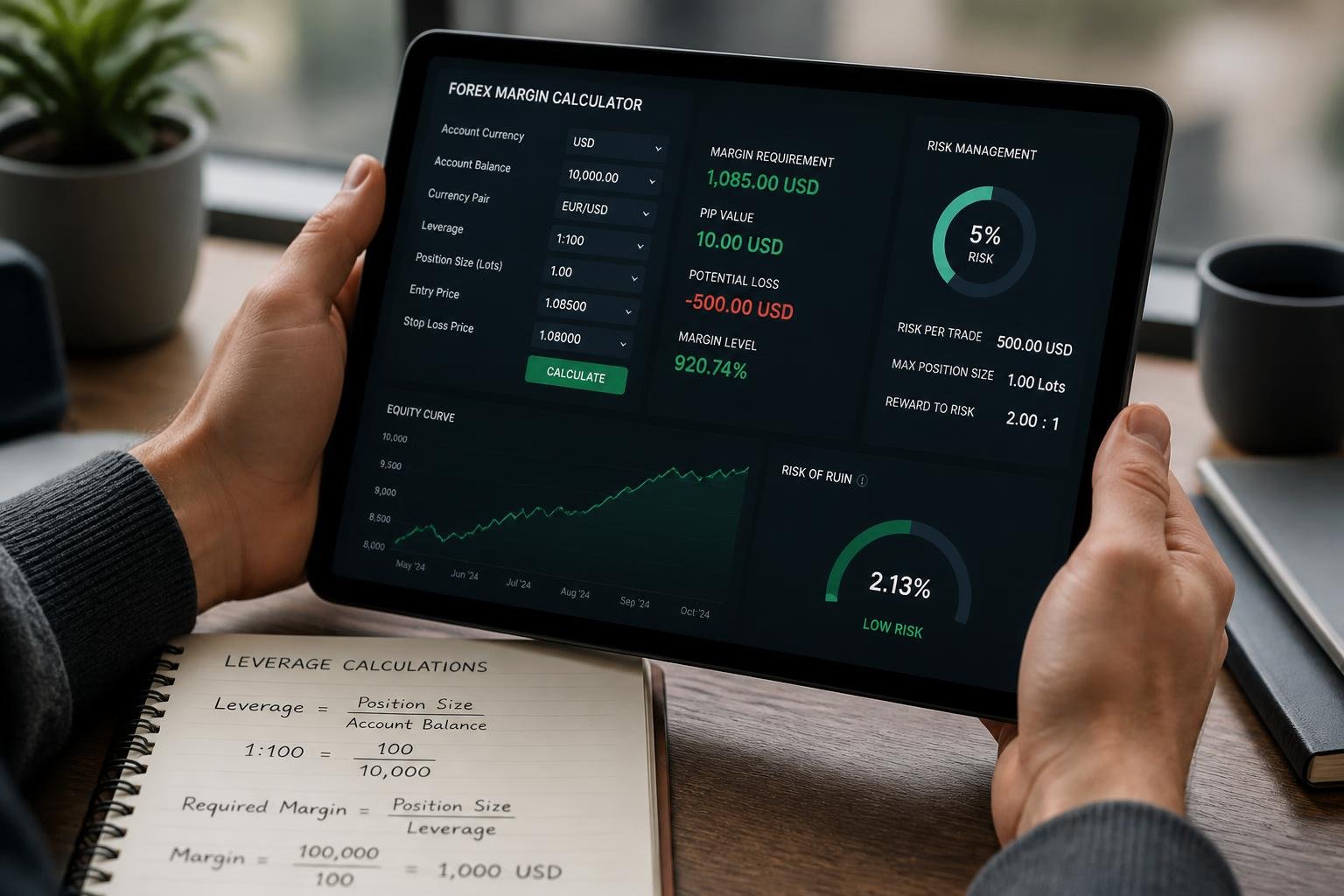
SEO description: Visual reference for the margin arithmetic section of the leverage guide.
Offshore
1:500 and 1:1000 offshore leverage — when it makes sense and when it doesn't
Offshore-regulated brokers routinely offer 1:500, 1:1000 or even 1:2000 leverage. For a disciplined trader running the 1% rule, this is essentially free capital efficiency. For an undisciplined trader who sizes positions based on 'what margin allows', it is a fast track to a zero balance.
The mathematics do not care. What changes with offshore high leverage is the environment around it: usually no negative balance protection, no compensation scheme, and often more aggressive stop-out behaviour during gaps. If you trade on offshore leverage, size as if you were on 1:30 and let the extra room simply reduce collateral.
Risk mechanics
Margin calls, stop-outs and how positions get liquidated
When your equity drops so that margin level (equity ÷ used margin) falls below the broker's margin call level, you get a warning — usually delivered as a platform notification. At stop-out level, the broker starts closing your positions in loss order until margin level is restored.
This process is faster than most traders realise. During a gap or a very sharp move, positions can go from healthy to fully liquidated inside seconds. Negative balance protection means you cannot owe the broker after this, but it does not protect you from losing the deposit.
The practical implication: never rely on the stop-out mechanism as your risk control. Always place hard stops at the position level, sized by the 1% rule, so that market drawdown — not margin arithmetic — determines your exit.
Mistakes
The five most common leverage mistakes retail traders make
Key points
- Sizing positions from available margin instead of from risk per trade.
- Increasing leverage after a losing streak to 'make it back' — the classic path to a blown account.
- Holding positions overnight without accounting for margin buffer against gap risk.
- Trading multiple correlated pairs as if they were independent (long EUR/USD + short USD/CHF + long AUD/USD = one big USD-short bet).
- Confusing the leverage the broker offers with the leverage you should use.
Checklist
Leverage checklist before you open a live account
Step-by-step checklist
- 1Decide your maximum risk per trade in dollars (1% of equity is the standard).
- 2Choose leverage that reduces locked collateral without changing position size.
- 3Check the broker's margin call and stop-out levels — they vary from 20% to 100%.
- 4Confirm negative balance protection applies to your account and jurisdiction.
- 5Model a worst-case gap scenario on your typical position size before funding.
Recommended internal reads
Trusted external sources
Verified references from high-authority sources supporting the regulation, platform and investor-protection concepts in this guide.
See the best forex brokers ranking
Before opening an account, compare brokers by regulation, spreads, platforms, reputation, bonuses, support and trader profile. The BrokerTrusted ranking helps you filter options with clarity.
See best forex brokersFrequently asked questions
What is the safest leverage for a beginner?
For a beginner, the leverage ratio is almost irrelevant if you apply the 1% rule. 1:30 on a regulated account is fine and gives ample position size for realistic risk levels. What matters is disciplined position sizing, not the ratio.
Is 1:500 leverage dangerous?
1:500 leverage in itself is not dangerous — it simply lowers required margin. What is dangerous is sizing positions based on available margin instead of on risk per trade. Used correctly, high leverage frees capital; used incorrectly, it accelerates drawdowns.
What is the maximum leverage allowed?
Under FCA, ESMA and ASIC retail rules, major forex pairs are capped at 1:30. Non-majors and gold are 1:20, commodities 1:10, equities 1:5, crypto 1:2. Offshore-regulated brokers can offer up to 1:1000 or more without regulatory caps.
How does a margin call work?
When account equity divided by used margin drops below the broker's margin call level (usually 100%), the platform warns you and blocks new orders. If it drops further to the stop-out level (usually 50%), the broker automatically closes losing positions to restore margin level.
Can I lose more than my deposit?
Not on a regulated retail account with negative balance protection — the broker absorbs any negative balance after stop-out. On offshore accounts without this protection, yes, you can theoretically go negative during a violent gap.
What is the 1% rule?
The 1% rule states you should never risk more than 1% of account equity on a single trade. From that dollar amount and your stop distance, you derive the correct position size — leverage becomes only a capital-efficiency choice, not a risk choice.
Related articles

How to Choose a Trusted Forex Broker in 2026: The Complete Due-Diligence Guide
A senior-level guide to picking a trusted forex broker in 2026 — how to verify regulation, evaluate segregation of funds, compare real costs and spot red flags before you deposit.

Forex Spreads and Real Trading Costs in 2026: How to Compare Brokers Like an Analyst
Learn how to compare forex brokers by their real trading cost — spread, commission, swap and slippage — with worked examples on major and minor pairs.
Forex Risk Management: Protect Your Capital 2026
Position sizing, stop placement and portfolio-level risk controls.
Forex Trading Psychology in 2026
How discipline and emotional control interact with leverage decisions.