

Executive summary
Every trader eventually discovers that the hardest part of this profession is not analysis. It is the gap between the plan they wrote when calm and the actions they take when the market is moving. That gap is the entire subject of trading psychology.
This guide covers the concrete, teachable side of psychology: the cognitive biases that reliably damage trading decisions, the routines professional traders use to reduce emotional interference, the drawdown protocols that prevent one bad day from becoming one bad year, and the daily habits that separate consistent operators from serial retail failures.
Nothing here is motivational content. Everything is operational.
Key takeaways
- Emotion cannot be eliminated — only routed through a rule-based process that removes the decision from the moment.
- Loss aversion, confirmation bias and recency bias are the three most damaging biases in retail trading.
- Revenge trading after a loss is the single most common account killer.
- A pre-market routine and a post-trade journal are the two habits with the highest ROI on discipline.
- Process orientation — being graded on decision quality rather than P&L — is the mindset shift that separates pros from amateurs.
Foundations
Why psychology, not analysis, is the real limiter
Ask any experienced trader what caused their worst losses and almost none will say 'my analysis was wrong'. They will say: 'I moved the stop', 'I doubled down', 'I chased', 'I traded when I shouldn't have', 'I sized up after two winners'. Each of those is a psychological failure, not an analytical one.
This matters because retail education focuses almost entirely on the analytical side. Traders can learn a valid strategy in a few months, but applying it consistently for years requires a completely different skill set — one that has to be built deliberately.
Biases
The cognitive biases that reliably destroy trading accounts
Behavioural finance has catalogued dozens of biases that affect trading. Three dominate retail outcomes.
Key points
- Loss aversion: the pain of a loss is roughly twice the pleasure of an equal gain (Kahneman & Tversky). This makes traders hold losers too long ('let it come back') and cut winners too early ('lock it in').
- Confirmation bias: once in a position, we unconsciously seek information that supports it and dismiss information that contradicts it. This is why the average retail trader averages down.
- Recency bias: the last few trades weigh disproportionately on the next decision. Two wins in a row triggers oversizing; two losses in a row triggers hesitation or revenge trading.
Revenge
Revenge trading — the account killer
The single most reliably destructive pattern in retail forex is revenge trading: taking an impulsive trade immediately after a loss, usually at 2–3× normal size, driven by the emotional need to 'get back' what was just lost. It bypasses every rule the trader has, and it happens to almost everyone.
The fix is mechanical, not motivational. After any stop-out, force a mandatory cool-down: stand up, walk away from the screen, wait a defined period (30–60 minutes minimum). Some prop firms enforce this at the software level, closing the trading platform for a set time after certain loss thresholds.
Warning
If you feel a strong urge to re-enter immediately after a loss, that feeling is not a signal — it is the exact opposite. Close the platform for the day.
Overtrading
Overtrading and how to recognise it in yourself
Overtrading is taking more trades than your strategy calls for — usually because the mind confuses activity with productivity. The result is death by a thousand cuts: individually small losses that compound into a serious drawdown while spreading focus so thin that quality setups are missed.
Symptoms: taking trades outside your written setup criteria, opening positions on impulse after watching the chart 'too long', increasing frequency after a losing morning, or entering because you feel you 'should be doing something'.
The counter is a hard daily trade limit — maximum three trades a day is a common rule for discretionary traders. Once the limit is hit, close the platform. This forces selectivity into every entry.
Compare brokers before you deposit
Independent rankings on regulation, spreads, platforms and best-fit trader profiles at BrokerTrusted.
Routines
The pre-market and post-market routines that create consistency
Consistent traders share almost identical routines. A pre-market routine (15–30 minutes before session open): review the higher-timeframe bias, mark key levels, note the economic calendar and identify news blackouts, review the previous day's journal, and confirm no personal-life factors (poor sleep, stress) that should keep you flat today.
A post-market routine (10–15 minutes after session close): log every trade taken with entry, exit, R risked and R result, screenshot the setup, tag by setup type, write one sentence on execution quality. Once a week, aggregate the journal and review by setup type.
The routines take under an hour per day combined. They are the single highest-ROI activity in retail trading — nothing else comes close.
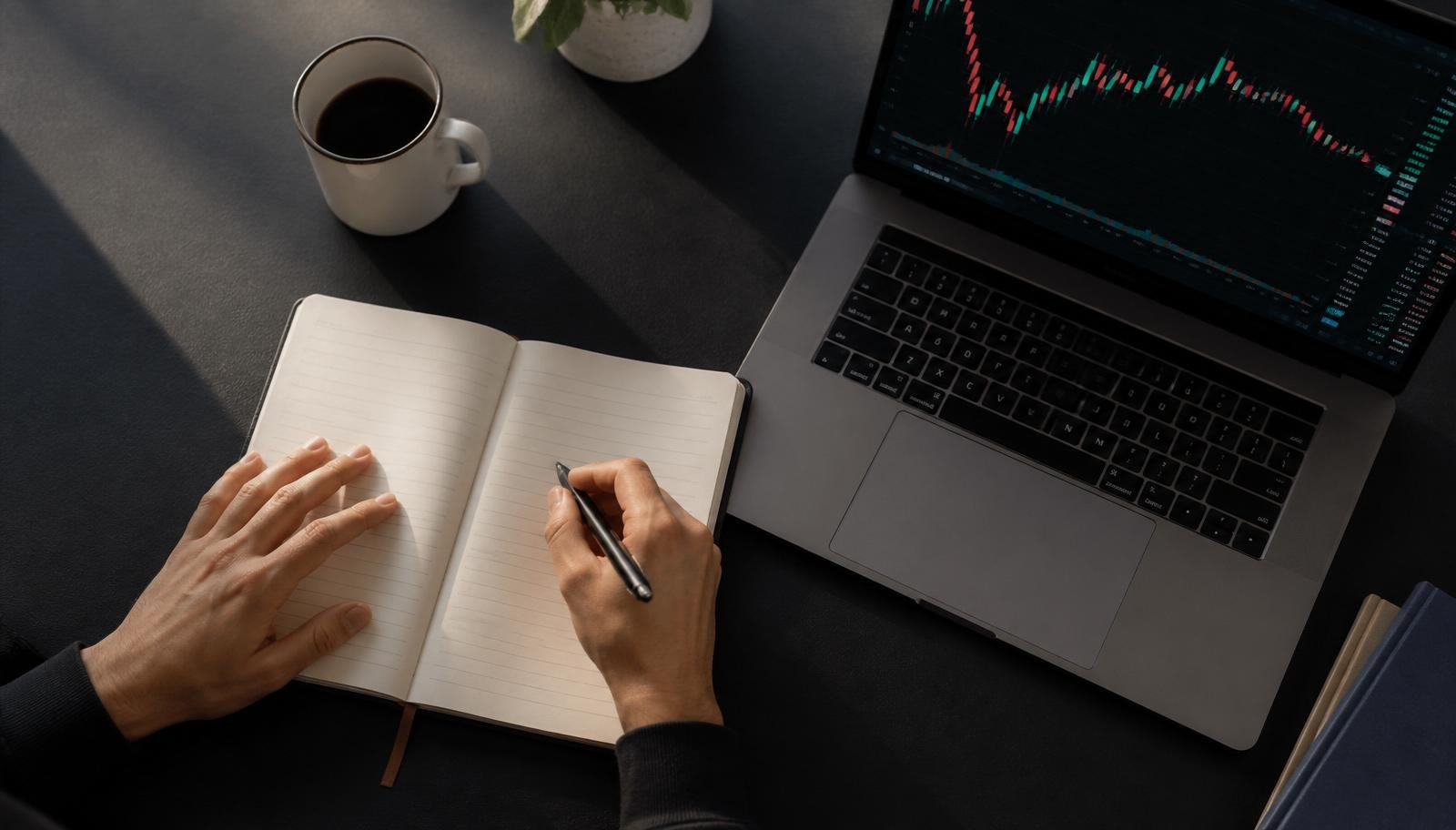
SEO description: Reference image for the section on post-trade routines and reset rituals after losses.
Mindset
Process orientation vs outcome orientation
The mental shift that separates professionals from amateurs is grading yourself on the quality of your decisions, not the outcome of any single trade. A well-executed trade that hits its stop is a good trade. A poorly-executed trade that hits its target is a bad trade — you got paid for a mistake, and the reinforcement will hurt you long-term.
Grade each trade on: was it within my written strategy? Was position size correct? Was the stop where it should be? Was the target based on structure? Did I follow my exit plan? A 5/5 execution that loses is not the market's fault or yours — it is the natural variance of a positive-expectancy system. A 3/5 execution that wins is a warning.
Drawdown
Surviving drawdowns — the psychological rules
Every profitable trader has periods where the equity curve drops 5–20%. What separates survivors from casualties is the psychological response. The pro response looks the same everywhere: at -5% drawdown, cut risk in half. At -10%, stop trading and review journal for pattern breaks. At -15%, take a full week off screen.
During a drawdown, the strongest urge is to increase size to 'catch up'. This is exactly the wrong response — it accelerates the drawdown while adding emotional strain. Codify your drawdown rules in writing when you are calm, and treat them as non-negotiable when you are not.
Basics
The physical basics almost every retail trader ignores
Key points
- Sleep: less than 6 hours reliably reduces decision quality. Trade smaller or don't trade at all after a bad night.
- Exercise: 30 minutes of aerobic activity before session start measurably lowers cortisol and improves focus.
- Nutrition: heavy meals right before trading cause energy crashes and impulsive decisions. Eat light during session hours.
- Screen breaks: five-minute breaks every hour prevent the tunnel vision that leads to overtrading.
- Life outside markets: traders whose entire identity is tied to trading tend to make emotional decisions after losses. Structural life balance is a risk-management tool.
Checklist
Daily discipline checklist
Step-by-step checklist
- 1Did I sleep at least 7 hours? If no, reduce risk or don't trade.
- 2Have I done my pre-market routine (levels, calendar, bias review)?
- 3Am I emotionally settled — no arguments, no personal stress today?
- 4Have I written my plan for each trade before entering it?
- 5Am I within my daily trade limit and daily loss limit?
- 6After each trade, did I log the outcome and grade execution?
- 7At end of session, did I close the platform and disconnect?
Compare brokers before you deposit
Independent rankings on regulation, spreads, platforms and best-fit trader profiles at BrokerTrusted.
Recommended internal reads
Trusted external sources
Verified references from high-authority sources supporting the regulation, platform and investor-protection concepts in this guide.
See the best forex brokers ranking
Before opening an account, compare brokers by regulation, spreads, platforms, reputation, bonuses, support and trader profile. The BrokerTrusted ranking helps you filter options with clarity.
See best forex brokersFrequently asked questions
How do I control emotions when trading forex?
You do not eliminate emotion — you route it through a rule-based process. Written strategy, fixed risk per trade, pre-market routine, mandatory cool-down after losses, and daily trade limits together reduce emotional interference to a manageable level.
How do I stop revenge trading?
Enforce a mandatory cool-down after every loss — minimum 30–60 minutes away from the screen. Codify this in writing before you start trading. If the urge to immediately re-enter appears, that urge is the signal to close the platform for the day.
What is overtrading?
Overtrading is taking more trades than your strategy calls for, usually driven by the confusion of activity with productivity. It leaks capital through small losses while spreading focus so thin that quality setups are missed. A daily trade limit is the standard counter.
How long does it take to become a disciplined trader?
Most traders need 12–24 months of live screen time, journaling and iterative refinement to develop consistent discipline. This is not a matter of willpower — it is skill acquisition, and it takes as long as any other complex skill.
Do professional traders feel fear and greed?
Yes. What is different is that they have built external rules and routines that make the emotional response irrelevant to their actions. The goal is not to stop feeling fear — it is to make sure fear never touches the entry, stop or size.
Is meditation useful for traders?
Many traders find that a short daily meditation or breathing practice measurably reduces reactivity to intraday moves. It is not required — the practical routines described in this guide matter more — but it is a low-cost addition with documented benefits for focus and impulse control.
Related articles

How to Choose a Trusted Forex Broker in 2026: The Complete Due-Diligence Guide
A senior-level guide to picking a trusted forex broker in 2026 — how to verify regulation, evaluate segregation of funds, compare real costs and spot red flags before you deposit.
Forex Spreads and Real Trading Costs in 2026: How to Compare Brokers Like an Analyst
Learn how to compare forex brokers by their real trading cost — spread, commission, swap and slippage — with worked examples on major and minor pairs.
Forex Risk Management 2026
The mechanical framework that supports every psychological rule in this guide.
How to Choose a Trusted Forex Broker in 2026
Trading psychology is easier when the broker holding your money is not another source of stress.