Executive summary
Every year a new wave of retail traders arrives at the same fork in the road: forex or stocks? The answer is not universal. Each market rewards a different personality, tolerates a different capital base and punishes a different set of mistakes.
This guide compares the two markets on the dimensions that actually matter for a beginner in 2026 — costs, leverage, capital requirements, liquidity, session hours, learning curve, taxation and psychological fit — and gives a clear recommendation for the most common trader profiles.
Nothing here is a pitch for either market. Both can be traded profitably; both can destroy a retail account. The point is to choose the one that fits your circumstances.
Key takeaways
- Forex has lower entry capital, higher leverage, tighter costs on majors and 24/5 access — best fit for time-poor traders with small starting capital.
- Stocks have deeper fundamental drivers, less leverage, longer holding horizons and stronger regulatory protections — best fit for investors and swing traders with larger capital.
- Forex majors are typically less volatile than individual stocks; a 1% daily move on EUR/USD is a large day, while a 5% move on a single stock is normal.
- The PDT rule in the US caps day trading in equities below $25,000 accounts — forex has no equivalent restriction.
- For a total beginner in 2026 with limited capital and full-time obligations, forex majors on a regulated broker offer the lower barrier to entry.
Foundations
What each market actually is
The foreign exchange market is a decentralised over-the-counter network where currencies are exchanged in pairs. It has no central exchange, trades 24 hours a day from Sunday evening to Friday evening UTC, and averages more than USD 7.5 trillion in daily volume according to the latest BIS Triennial Survey — making it by far the largest financial market in the world.
Stock markets are centralised exchanges where shares of individual companies are bought and sold during defined session hours (9:30–16:00 New York time for the NYSE and Nasdaq, plus limited pre- and post-market sessions). Trading is regulated by securities commissions (SEC in the US, FCA in the UK, ESMA in Europe) with strict disclosure and market-integrity rules.
A forex position expresses a view on the relative strength of two currencies. A stock position expresses a view on the value of one company. That single structural difference cascades into every other comparison in this article.
Capital
Capital requirements — how much do you actually need to start?
Forex has one of the lowest capital barriers of any tradable market. Regulated brokers commonly accept minimum deposits of USD 100–200, and micro-lot trading (1,000-unit contract size) lets a beginner risk 0.5–1% per trade meaningfully even on a small account.
US equity brokers now offer commission-free trading and fractional shares, so the capital barrier is also low — but the Pattern Day Trader (PDT) rule effectively caps day trading in margin accounts under USD 25,000 to three round trips per five business days. Below that threshold, US-based day traders are essentially locked out of equities. Forex has no equivalent restriction anywhere in the world.
For swing trading and investing, both markets are accessible with small capital. For active day trading with limited starting funds, forex is structurally more accessible.
| Factor | Forex | Stocks (US retail) |
|---|---|---|
| Minimum practical account | USD 200–500 | USD 500–1,000 |
| Day-trading capital minimum | None | USD 25,000 (PDT rule) |
| Micro contract size | 1,000 currency units | Fractional shares (most brokers) |
| Leverage available (retail, tier-1) | 1:30 on majors | 1:2 on margin |
Leverage
Leverage: forex offers more, and that is not automatically good
Under FCA, ESMA and ASIC retail rules, forex majors are available at up to 1:30 leverage. US retail equities cap at 1:2 (Regulation T margin). This is a large structural difference: on the same capital, a forex trader can express the same percentage risk with far less locked collateral.
That is efficient — but only if position sizing is disciplined. As we cover in depth in our leverage guide, leverage is a collateral ratio, not a risk ratio. High leverage lets professional traders be capital-efficient; it also lets undisciplined beginners size positions ten times too large. The 1% rule (never risk more than 1% of equity per trade) applies the same way in both markets and makes the leverage ratio almost irrelevant to outcomes.
Costs
Trading costs: forex majors are cheaper on a percentage basis
Trading EUR/USD on a raw-spread account at a tier-1 broker costs roughly 0.1 pip spread + USD 7 round-turn commission on a standard lot = approximately USD 8 per USD 100,000 notional traded. That is 0.008% of the position size — extremely low on a percentage basis.
Trading a US large-cap stock (say AAPL at USD 200) with commission-free retail brokers is effectively free in commission but includes payment-for-order-flow spread costs of a few tenths of a cent per share. On a 100-share USD 20,000 position, effective cost is often USD 5–15 — around 0.03–0.08% of the position size, several times higher than the forex equivalent.
For active traders, this cost difference compounds significantly. For long-term investors doing 5 trades a year, it is immaterial.
Compare brokers before you deposit
Independent rankings on regulation, spreads, platforms and best-fit trader profiles at BrokerTrusted.
Volatility
Volatility: forex majors are calmer than most individual stocks
EUR/USD's average daily true range is typically 40–90 pips, which is about 0.4–0.9% of the price. A 1.5% daily move is a very large day and often coincides with a central bank event. Individual US large-cap stocks routinely move 2–5% on earnings, single-name news or sector rotation — with 10%+ moves common on quarterly results.
This means forex offers a smoother volatility profile at the majors level, which is useful for beginners still calibrating risk. It also means the maximum realistic daily gain on a properly-sized forex trade is smaller than on a well-timed single-stock catalyst. Different profiles.
Exotic forex pairs and minor pairs can be as volatile as any individual equity. The volatility comparison above holds specifically for major pairs (EUR/USD, GBP/USD, USD/JPY, USD/CHF, USD/CAD, AUD/USD, NZD/USD).
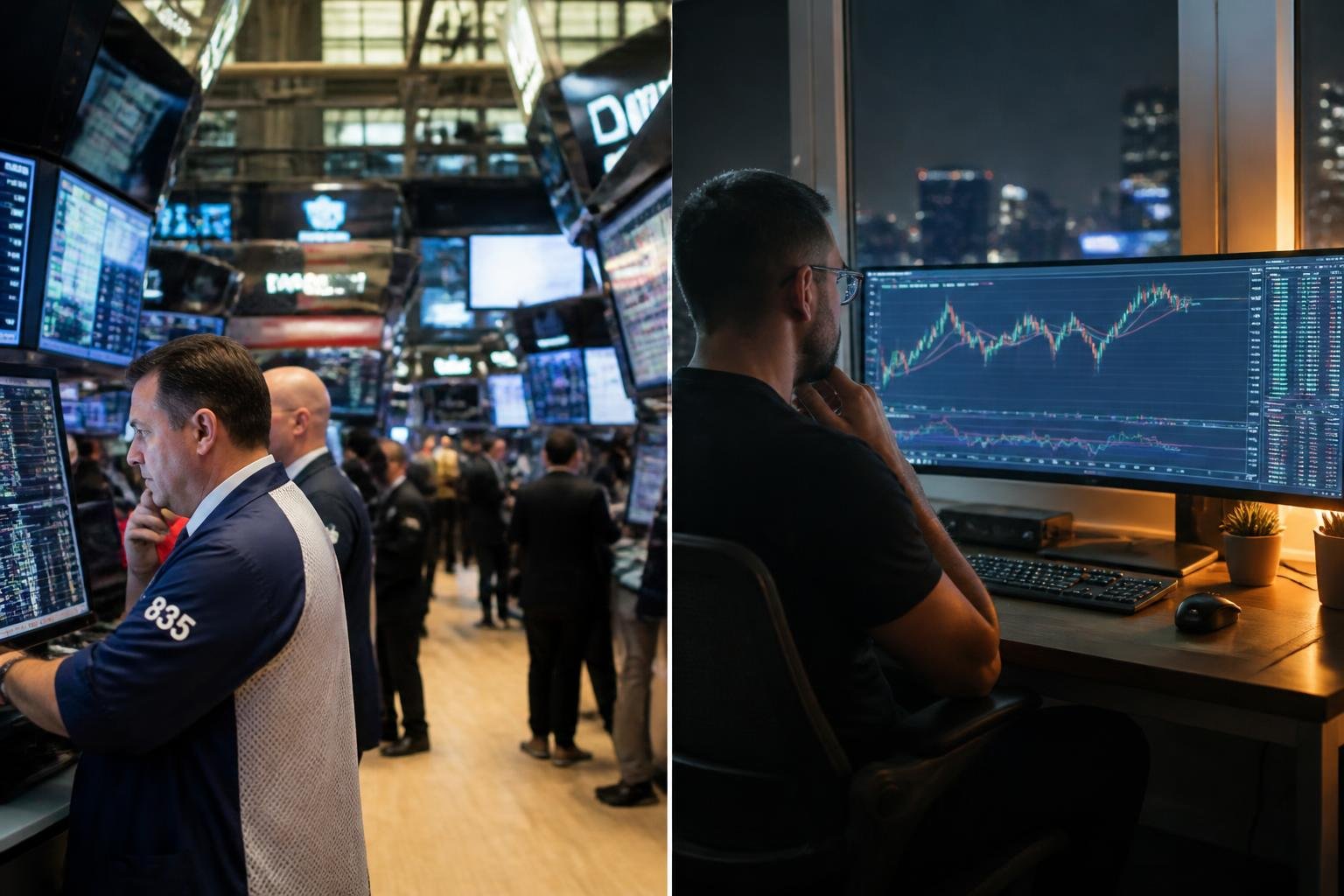
SEO description: Reference image for the market structure and access section of the forex-vs-stocks guide.
Hours
Market hours: 24/5 forex vs 6.5-hour equity session
Forex is a 24-hour market from Sunday evening (Sydney open) to Friday evening (New York close). This is a genuine advantage for traders in Asia and Europe who want to trade the US session outside of local working hours, or for anyone with a full-time job who trades during evenings or early mornings.
US equities trade during a 6.5-hour session (9:30–16:00 ET) with limited liquidity outside those hours. European exchanges have similar 8–9 hour windows. This concentration of activity means most retail equity trading happens in a narrow window that may not fit a working schedule.
For a beginner with limited daytime availability, forex's session flexibility is a real practical advantage.
Learning
Learning curve and what you actually have to master
Forex requires learning macro drivers (central bank policy, interest rate differentials, inflation, growth, current account dynamics), technical analysis on 24-hour continuous charts, and the mechanics of leverage. It rewards traders who enjoy following global monetary policy and cross-asset flows.
Stocks require learning company-level fundamentals (revenue, margins, cash flow, competitive dynamics), sector context, catalyst calendars (earnings, product launches, guidance) and — for shorter-term traders — market microstructure (order flow, dark pools, options positioning). It rewards traders who enjoy digging into individual businesses.
Both learning curves are steep. Forex is arguably narrower and more standardised (the majors trade almost the same way every day); stocks is broader but each individual name has its own personality.
Tax
Taxation — a jurisdiction-specific note
Tax treatment of forex vs stocks differs significantly by country and can shift the net-of-tax attractiveness of one over the other. In the US, spot forex is normally taxed under Section 988 (ordinary income) but can be elected under Section 1256 (60/40 long/short-term treatment) in some cases; equities follow standard capital gains rules with the 1-year long-term threshold.
In the UK, spread betting on forex is currently tax-free for retail (subject to conditions), while stock trading is subject to capital gains tax. In the EU, CFDs on forex and equities generally fall under capital gains regimes with jurisdiction-specific rates.
This is not tax advice — always consult a qualified professional in your jurisdiction. But it is worth understanding, because two markets with similar gross returns can produce very different net-of-tax results.
Warning
Tax law changes. Always confirm current rules with a local qualified professional before choosing a market based on tax treatment.
Recommendation
Which one should you actually start with?
| Your profile | Recommended market |
|---|---|
| USD 300–2,000 capital, full-time job, wants to day-trade evenings | Forex majors |
| USD 5,000+ capital, interested in fundamentals, long horizon | Stocks |
| USD 500 capital, wants to learn discretionary trading | Forex majors (micro lots) |
| USD 25,000+ capital, US-based, wants active day trading | Either (PDT rule not binding) |
| Focused on macro / central bank policy / geopolitics | Forex |
| Focused on individual company analysis / dividends | Stocks |
Compare brokers before you deposit
Independent rankings on regulation, spreads, platforms and best-fit trader profiles at BrokerTrusted.
Final
Editorial take
If we had to give a single recommendation for a total beginner in 2026 — small capital, limited time, no strong preference for either macro or company analysis — we would choose forex majors on a tier-1 regulated broker. Lower capital barrier, no PDT restriction, tighter percentage costs on majors, and 24/5 access make it the more accessible starting point.
For a beginner with USD 10,000+ in capital, interest in fundamentals and a long time horizon, stocks are the better fit. Both markets are valid; both require the same disciplined risk framework. The right choice is the one you will actually apply consistently.
Recommended internal reads
Trusted external sources
Verified references from high-authority sources supporting the regulation, platform and investor-protection concepts in this guide.
See the best forex brokers ranking
Before opening an account, compare brokers by regulation, spreads, platforms, reputation, bonuses, support and trader profile. The BrokerTrusted ranking helps you filter options with clarity.
See best forex brokersFrequently asked questions
Is forex easier than stocks for beginners?
Forex majors have a smaller opportunity set (about 7 currency pairs cover most retail volume) and a more standardised behaviour, which makes them easier to learn as a system. Stocks have thousands of names with individual personalities, which is broader but takes longer to master. Neither is 'easy' in absolute terms.
Which is more profitable, forex or stocks?
Both markets can be highly profitable and both can destroy accounts. The dominant factor in profitability is not the market choice — it is the trader's discipline, risk management and execution consistency. A great trader will do well in either; a poor trader will fail in both.
Can I trade both forex and stocks at the same broker?
Yes. Modern brokers like Interactive Brokers, Saxo Bank and several MT5-based CFD brokers offer both forex and equities from a single account. This is convenient but means you must manage total portfolio heat carefully across both asset classes.
What is the PDT rule and does it apply to forex?
The Pattern Day Trader rule is a US-specific FINRA regulation that requires equity margin accounts under USD 25,000 to limit day trading to three round trips per five business days. It does not apply to forex, which is one reason many US-based day traders start there.
Are forex majors more volatile than the S&P 500?
On a percentage basis, no. EUR/USD's daily range is typically 0.4–0.9%; the S&P 500's is 0.6–1.2%. Individual large-cap stocks are far more volatile than either. Forex minor and exotic pairs, however, can rival or exceed equity volatility.
Can I start trading forex with $100?
Technically yes, most regulated brokers accept $100 minimums. Realistically, $100 does not give room for proper 1% risk sizing on any meaningful trade — you would be forced into micro-lots with tight stops that leave little margin for market noise. USD 500–1,000 is a more realistic starting point for a learning account.
Related articles

How to Choose a Trusted Forex Broker in 2026: The Complete Due-Diligence Guide
A senior-level guide to picking a trusted forex broker in 2026 — how to verify regulation, evaluate segregation of funds, compare real costs and spot red flags before you deposit.
Forex Spreads and Real Trading Costs in 2026: How to Compare Brokers Like an Analyst
Learn how to compare forex brokers by their real trading cost — spread, commission, swap and slippage — with worked examples on major and minor pairs.
How to Choose a Trusted Forex Broker in 2026
Once you have chosen the market, choose the broker with the same rigour.
Forex Leverage Complete Guide 2026
Understand why forex leverage is higher — and why that changes nothing about correct position sizing.